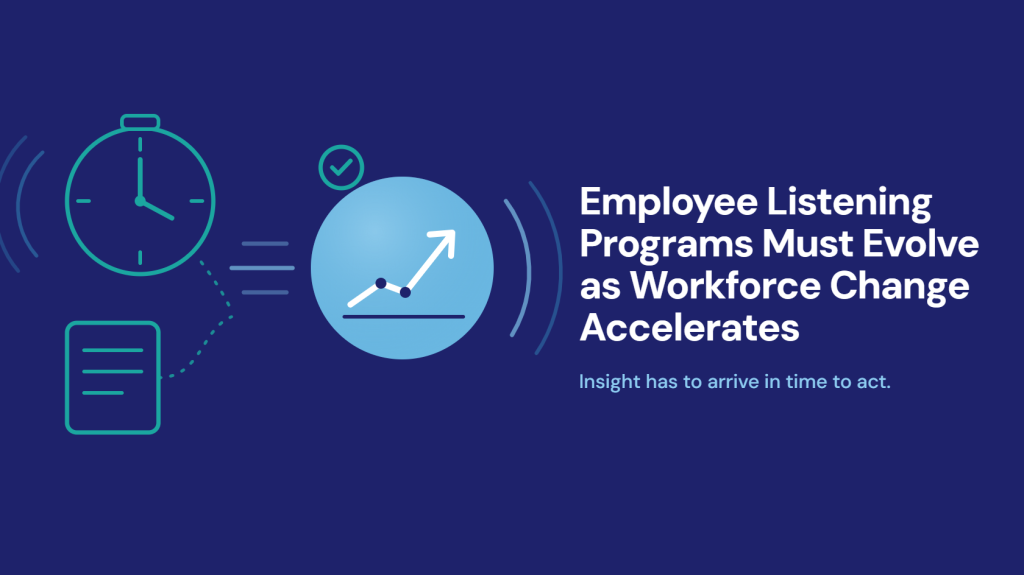
Employee Listening Programs Must Evolve as Workforce Change Accelerates
Workforce conditions are rapidly changing jobs, skills, workflows, manager expectations and employee experience. AI is accelerating some of that change, but it is part of a broader environment of workforce uncertainty and transformation.
On the other hand, employee surveys have not fundamentally changed in nearly 100 years, until now. We moved from managers walking around with clipboards, to paper surveys in the 1970s, to software in the 2000s that digitized collection and reporting. But the basic model remained the same: ask employees questions, collect responses, analyze the results and act later. In many ways, we are still using a 100-year-old model with better technology. The problem is that the technology has cost us billions of dollars but the outcomes have not changed.
Traditional employee listening programs continue to provide valuable insight. The challenge is that much of the insight is retrospective and often disconnected from broader workforce data.
Workforce intelligence expands that capability by connecting employee voice, workforce data, technology, analytics and human judgment so leaders can identify meaningful change sooner and make more informed decisions.
Managed workforce intelligence provides an operating model for bringing those capabilities together without requiring HR to build and manage every component internally.
These new models are easy to implement, cost-effective, and higher impact than the traditional software-based listening programs.
See where your program stands: take the Workforce Intelligence Readiness Assessment →
Workforce Change Is Accelerating
Jobs are changing. Skills are changing. Workflows are changing. Managers are being asked to lead differently, and employee expectations continue to evolve.
AI is an important accelerator, but it is not the only source of change.
Senior management is focused on automation and efficiencies creating uncertainty among the workforce. It is more important than ever that employees feel they have a voice.
For employee listening programs, the implication is straightforward: organizations need to understand workforce conditions quickly enough to determine what matters and where action may be needed while there is still time to influence the outcome.
Traditional employee listening remains an important part of that process, but the current model does not provide the speed, context and integration required in a faster-moving environment.
Traditional Employee Listening Programs Are Often More Retrospective Than the Environment Requires
Technology has improved employee listening significantly but much of the underlying process still follows a familiar sequence:
- Listen
- Analyze
- Report Development
- Report Distribution
- Data Interpretation
- Act
Paper surveys became digital. Reporting became faster. Dashboards became more sophisticated. Analytics became easier to access.
That process can provide important insight into employee experience.
The limitation is often timing, cost and resources.
Listening data may be analyzed after a survey or listening event has ended. By the time findings are reviewed, shared and discussed, workforce conditions may already have changed.
Perceptyx’s 2025 State of Employee Listening research found that while 71% of employees said their organization shares survey results, only 51% reported that improvements resulted from employee feedback.
The issue is not whether organizations are listening. It is how quickly listening leads to useful insight and action. Senior HR leaders need to ask themselves if their HR teams are spending more time on setting up and implementing the survey or more time on the changes that will impact organizational outcomes?
More Data Does Not Automatically Create More Visibility
Most organizations already have substantial workforce data.
That may include:
- Engagement surveys
- Onboarding and exit feedback
- Pulse surveys
- Turnover and retention data
- HRIS information
- Performance data
- Absence data
- Manager observations
- Employee comments and qualitative feedback
The challenge is that these signals often sit in different systems, programs or teams.
Employee listening programs may provide a strong view of what employees are experiencing. Broader workforce data may show what is happening operationally.
When those sources remain separate, leaders may have plenty of information but still lack a clear view of what is happening across the workforce.
Connecting employee voice with broader workforce data makes it easier to identify patterns, understand possible drivers and determine what deserves attention. And AI enables possibilities in cost, resourcing and efficiencies that never existed before.
Employee Listening Programs Also Need to Provide Insight Sooner
Visibility alone is not enough.
Senior leaders have always needed to understand what is happening across the workforce, what is driving it, where risk may be developing and where action is needed.
Traditional employee listening programs can provide important answers to those questions.
The challenge is whether those answers arrive soon enough.
By the time listening data and other workforce signals are connected and interpreted, an issue may already be visible through turnover, performance, manager challenges or other business outcomes.
As workforce change accelerates, the time gap between signal, interpretation and action becomes more important.
A more responsive model helps organizations identify meaningful workforce change while it is developing rather than only after the impact is already visible. In the traditional software-based survey model, HR had to purchase software, implement it, train on it, create a survey design, send the survey, analyze it, manage users, distribute data and then act on it. This cycle would take months and many software providers say at least 17-31 hours per cycle. With the managed service model, set up to action is cut to days and weeks.
For example, many employers with distributed workforces experience their highest and most costly turnover in the first 100 days because of the investments in recruiting, onboarding and training. Yet these employees often do not participate in exit interviews, making it difficult to understand why they leave and how to break the cycle. Traditional software-only, in-house survey programs can add further delay, with several months passing before enough data is collected, analyzed and acted on.
An AI-enabled, people-led managed service model can be implemented in a week or less. Caller-led outreach improves participation, and employee feedback can be combined with turnover, tenure and other workforce data to identify at-risk locations and populations quickly. AI-enabled reporting can surface priorities and recommended actions in real time, while advisory support helps HR intervene with employees who may be at risk, reconnect with recent departures and continuously improve retention while it is happening. These programs can also cost roughly 25% less than traditional survey software alone.
From Employee Listening to Workforce Intelligence
Workforce intelligence builds on traditional employee listening rather than replacing it.
It connects employee voice with broader workforce data, analytics, technology and human judgment to provide a more current and integrated view of workforce conditions.
A workforce intelligence capability can help leaders:
- Identify meaningful workforce issues sooner
- Connect employee experience with workforce outcomes
- Understand what may be driving change
- Separate meaningful signals from noise
- Determine what deserves attention
- Support clearer decisions and action
- Measure whether interventions are working
The objective is not to predict every workforce issue.
It is to improve the organization’s ability to recognize meaningful change, understand what it means and respond with more time to influence the outcome.
Technology Is Only Part of the Capability
AI is finally changing employee listening in a meaningful way. The model is still people-led, but AI allows organizations to reach employees faster, combine and analyze data more quickly, and distribute insights in near real time.
The mistake would be to repeat what happened with employee engagement software: invest heavily in technology without materially improving outcomes. Engagement levels have remained stubbornly low despite massive investment in survey platforms.
The emerging model, often described as managed workforce intelligence, is AI-enabled and people-led. People remain at the center: building trust, reaching employees through multiple channels like phone calls, protecting confidentiality, interpreting context and leading change. AI like all technology does what it does best: reducing administration, combining data from multiple sources, identifying patterns, analyzing results and distributing insights quickly.
The result: give AI the work it can do faster and better, and give HR leaders, business leaders and front-line managers the timely, decision-ready insight they need to create change.
Organizations can start with a traditional survey and progressively move toward integrated listening and workforce intelligence, often with less administrative burden, fewer internal resources and faster time to action.
A functioning workforce intelligence capability requires:
The value comes from how those components work together.
Why Managed Workforce Intelligence Matters
Building a complete workforce intelligence capability internally requires more than technology.
Organizations need connected data, listening expertise, analysis, interpretation, program management, action planning and follow-through.
That requires time, capacity and specialized expertise.
Perceptyx’s 2026 research found that HR workload was the most frequently cited barrier to employee-listening success at 27%, followed closely by budget at 26%.
Managed workforce intelligence provides a different operating model.
Rather than requiring HR to assemble and operate every component internally, a managed approach brings technology, data, expertise and execution together in one functioning capability.
HSD’s managed workforce intelligence approach, Metrics HQ, combines employee voice, workforce data, technology and AI, HSD expertise and managed execution.
The model is designed to reduce the internal effort required to operate the capability while giving HR more capacity to focus on interpretation, executive decision support and action.
Evaluating Workforce Intelligence Readiness
The question is not whether traditional employee listening programs still have value. They do.
The question is whether the current approach provides the speed, visibility, flexibility and operating capacity required as workforce change becomes faster and more complex.
The Workforce Intelligence Readiness Assessment evaluates five areas:
- Speed and Emerging Risk
- Workforce Visibility and Connected Data
- Listening Flexibility and Responsiveness
- Operating Capacity and Cost
- Action and Executive Decision Support
Organizations do not need more data for its own sake. They need a clearer and more timely understanding of what is changing across the workforce, what matters and where action is needed.
Periodic engagement survey; HR-led; reporting is endpoint.
Multiple listening points: engagement, pulse, onboarding, exit.
Feedback across the employee lifecycle. Common measures, benchmarks, and governance create one listening system.
Employee voice combined with HRIS & business data: turnover, tenure, absences, performance. Analytics identify patterns, drivers, at-risk groups.
Move from explaining what happened to anticipating what may happen. AI/analytics identify emerging risks, leaders receive targeted insights, interventions are triggered, outcomes measured.